


US Airports
US airports power the largest and most complex aviation system in the world. Every day, millions of travelers move through a network that spans major international gateways, domestic hubs, and regional airports serving smaller communities. This system supports business travel, tourism, global trade, and military logistics, making airports a critical part of national infrastructure.
Each US airport serves a specific role shaped by geography, airline dominance, passenger demand, and global connectivity. Some airports function as international bridges between continents, while others act as domestic connectors or low-cost travel centers. Understanding how US airports differ helps travelers choose better routes, avoid delays, and find cheaper flights.
What Are US Airports?
US airports are federally regulated aviation facilities that support commercial, regional, and international air travel across the United States for passengers and cargo.
How Many Airports Are in the United States?
The United States has more than 19,000 airports, including public, private, military, and general aviation facilities. Around 500 airports offer scheduled commercial passenger service.
📊 State-by-State Major US Airports
California
- Los Angeles International Airport (LAX)
- San Francisco International Airport (SFO)
- San Diego International Airport (SAN)
- Oakland International Airport (OAK)
Texas
- Dallas/Fort Worth International Airport (DFW)
- George Bush Intercontinental Airport (IAH)
- Austin-Bergstrom International Airport (AUS)
- San Antonio International Airport (SAT)
Florida
- Miami International Airport (MIA)
- Orlando International Airport (MCO)
- Fort Lauderdale-Hollywood International Airport (FLL)
- Tampa International Airport (TPA)
New York
- John F. Kennedy International Airport (JFK)
- LaGuardia Airport (LGA)
- Newark Liberty International Airport (EWR)
Illinois
- Chicago O’Hare International Airport (ORD)
- Chicago Midway International Airport (MDW)
✈️ Airport Comparison by Airline Dominance
| Airport | Dominant Airline | Primary Role |
|---|---|---|
| ATL – Atlanta | Delta Air Lines | World’s busiest airport |
| DFW – Dallas/Fort Worth | American Airlines | Largest AA hub |
| DEN – Denver | United Airlines | Major domestic connector |
| MDW – Chicago Midway | Southwest Airlines | Low-cost domestic hub |
| LAS – Las Vegas | Multiple LCCs | High competition, cheap fares |
Which US Airports Have the Cheapest Flights?
US airports with the cheapest flights are usually large hubs with strong airline competition, such as Las Vegas (LAS), Orlando (MCO), Los Angeles (LAX), Chicago (ORD), and Dallas/Fort Worth (DFW).
US Airport Codes Explained
US airports use three-letter IATA codes. Some codes reflect historical airport names rather than city names.
- LAX – Los Angeles
- ORD – Orchard Field (Chicago)
- DFW – Dallas/Fort Worth
- ATL – Atlanta
- JFK – New York JFK
TSA Security at US Airports
- Liquids limited to 3.4 oz (100 ml)
- Electronics removed at most checkpoints
- TSA PreCheck offers faster screening
- Arrive 2 hours early for domestic flights
- Arrive 3 hours early for international flights
🧠 Quick Answers About US Airports
What is the largest airport in the US?
Denver International Airport is the largest airport in the United States by land area.
What is the busiest airport in the US?
Atlanta Hartsfield-Jackson International Airport is the busiest airport by passenger volume.
Do all US airports have TSA security?
Yes, all commercial US airports operate under TSA security regulations.
How early should I arrive at a US airport?
Arrive two hours early for domestic flights and three hours early for international flights.
How many international airports are in the US?
The United States has over 100 airports offering international passenger flights.
International Arrivals at US Airports
International travelers must clear US Customs and Border Protection at designated airports. Many major hubs offer Global Entry and automated passport kiosks to reduce wait times.
Future of US Airports
US airports are investing in terminal expansions, biometric boarding, sustainability projects, and improved passenger technology. Major upgrades are underway at JFK, LAX, ORD, and SFO.
Airport Travel Steps: Complete Check-In to Arrival Process
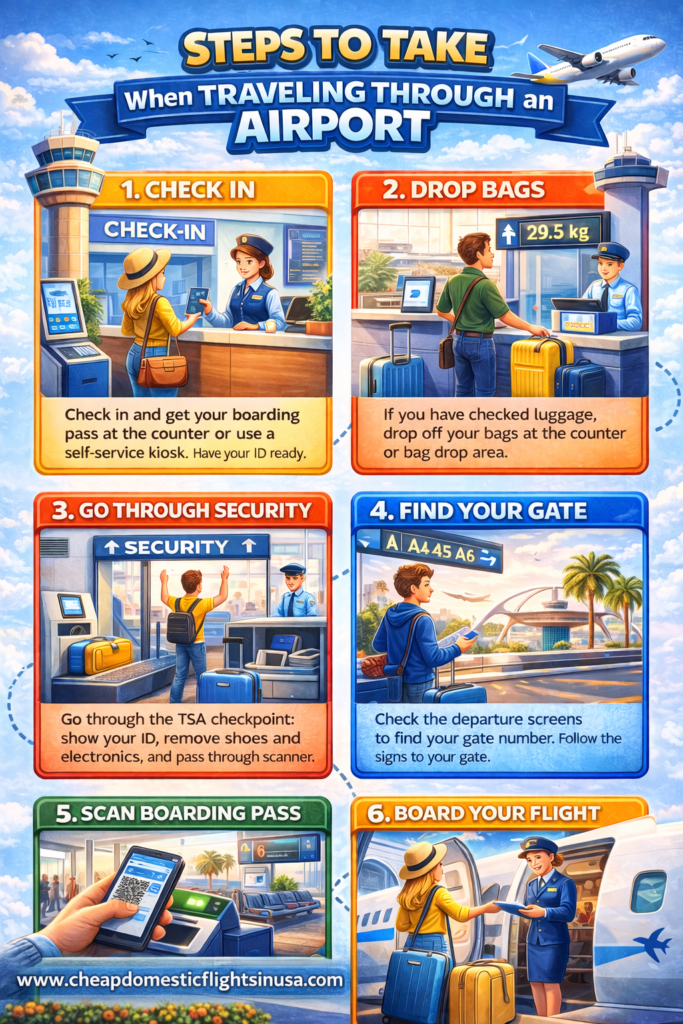
Traveling through an airport follows a predictable sequence. Understanding each step helps travelers save time, reduce stress, and move confidently from curbside to destination.
Arrival at the Airport
Arrive at least 2 hours before domestic flights and 3 hours before international flights. Use curbside drop-off or parking facilities depending on your travel plan.
Check-In
Check in online, at a self-service kiosk, or with an airline agent. You’ll receive your boarding pass and can check luggage if required.
Baggage Drop
Checked bags are weighed, tagged, and sent to the aircraft. Budget airlines may charge additional baggage fees at this stage.
Security Screening
Pass through TSA or security screening. Remove shoes, belts, electronics, and liquids according to airport security rules.
Passport Control (International)
For international departures, immigration officers verify passports and visas before allowing travelers to proceed.
Departure Gate
Proceed to your gate, verify boarding time, and listen for announcements. Gates may change, so check displays regularly.
Boarding
Board the aircraft by zone or group. Have your boarding pass and identification ready for scanning.
In-Flight Travel
Follow crew instructions, stow luggage properly, and enjoy onboard services depending on your airline and fare type.
Arrival & Immigration
Upon landing, international travelers go through immigration. Domestic travelers proceed directly to baggage claim.
Baggage Claim
Collect checked luggage from the assigned carousel. Report missing or damaged baggage to the airline immediately.
Customs (International)
Declare goods if required. Customs officers may inspect luggage before allowing exit.
Exit the Airport
Leave the airport using taxis, rideshare services, rental cars, public transportation, or hotel shuttles.
Airport Travel Steps – Common Questions
What are the steps when traveling through an airport?
The main airport steps are arrival, check-in, baggage drop, security screening, boarding, and baggage claim.
How early should I arrive at the airport?
Arrive at least two hours early for domestic flights and three hours early for international flights.
What is the first thing you do at the airport?
The first step is checking in online, at a kiosk, or at the airline counter to get your boarding pass.
Do I need to check in if I already checked in online?
If you have no checked bags, you can go straight to security with your boarding pass.
Where do you drop checked luggage?
Checked luggage is dropped at the airline counter or designated bag drop area.
What happens at airport security?
Travelers show ID, place items in bins, remove shoes if required, and pass through a scanner.
Do you go through security before finding your gate?
Yes, security screening happens before entering the departure gate area.
How do you find your gate at the airport?
Gates are listed on departure screens and airline apps. Follow airport signage.
When does boarding start?
Boarding usually starts 30 to 45 minutes before departure.
What documents do I need to board a plane?
You need a boarding pass and a valid ID or passport.
What happens after landing?
After landing, travelers exit the plane and proceed to baggage claim or immigration.
Where do you pick up luggage after a flight?
Checked bags are collected at baggage claim carousels.
Do international flights go through customs?
Yes, international travelers must clear immigration and customs.
How long does airport security take?
Security can take 10 minutes to over an hour depending on airport traffic.
Is TSA PreCheck faster?
Yes, TSA PreCheck usually provides faster security screening.
Can I bring liquids through security?
Liquids must be under 3.4 ounces and placed in a quart-size bag.
What happens if you miss boarding?
Missing boarding may result in losing your seat or rebooking fees.
What transportation options are at airports?
Airports offer taxis, rideshares, rental cars, shuttles, and public transit.
Is the airport process the same everywhere?
Most airports follow the same process, but international airports may have extra steps.
Are airports open 24 hours?
Many large airports operate 24 hours, but services may be limited overnight.